

This optional feature is included in all Tap Trackers plans.
The usual way to price line cleaning is to set a per-line rate, and everyone pays the same rate.
This is antiquated thinking.
Some establishments are super easy: walk-in is near the back door, the bar is close, you can get in anytime, the install is new, equipment is in great shape and the establishment has ample free parking and a loading dock right at the back door. These establishments are easy to clean, and we look forward to them.
Others have restricted hours; you can only get in 30 min before opening. There is no parking lot or a functioning sink behind the bar. The walk-in is cramped, and to make it worse, it is shared with the kitchen. The kegs are jumped, it has beer pumps, and the equipment is old and the owner doesn’t want to spend a penny to fix it. These are nightmare establishments.
You shouldn’t charge the same per line for these two establishments. Enter the Fee Multiplier.
What Are Fee Multipliers
Set your base rate - what is the lowest you would charge to clean a line? (See definition of a line)
Determine the increment by which you will increase the base for any operational challenges. Example: 50 cents, 75 cents, or a dollar. Example: if your base rate is $10, you may also charge $11, $12, or $13 per line depending on the challenges at the establishment.
Begin to think about a pricing scheme to determine how you will apply the multipliers. Example: every one challenge it moves up one tier. OR every two challenges it moves up a tier. Maybe some challenges are less significant, and you think that every two of those is equal to one larger challenge.
Identifying the Challenges
In the Establishment Details tab, in the Establishment Notes section, you will see options to identify any operational challenges that the establishment has under Bar, Fridge, and Location Notes sections:
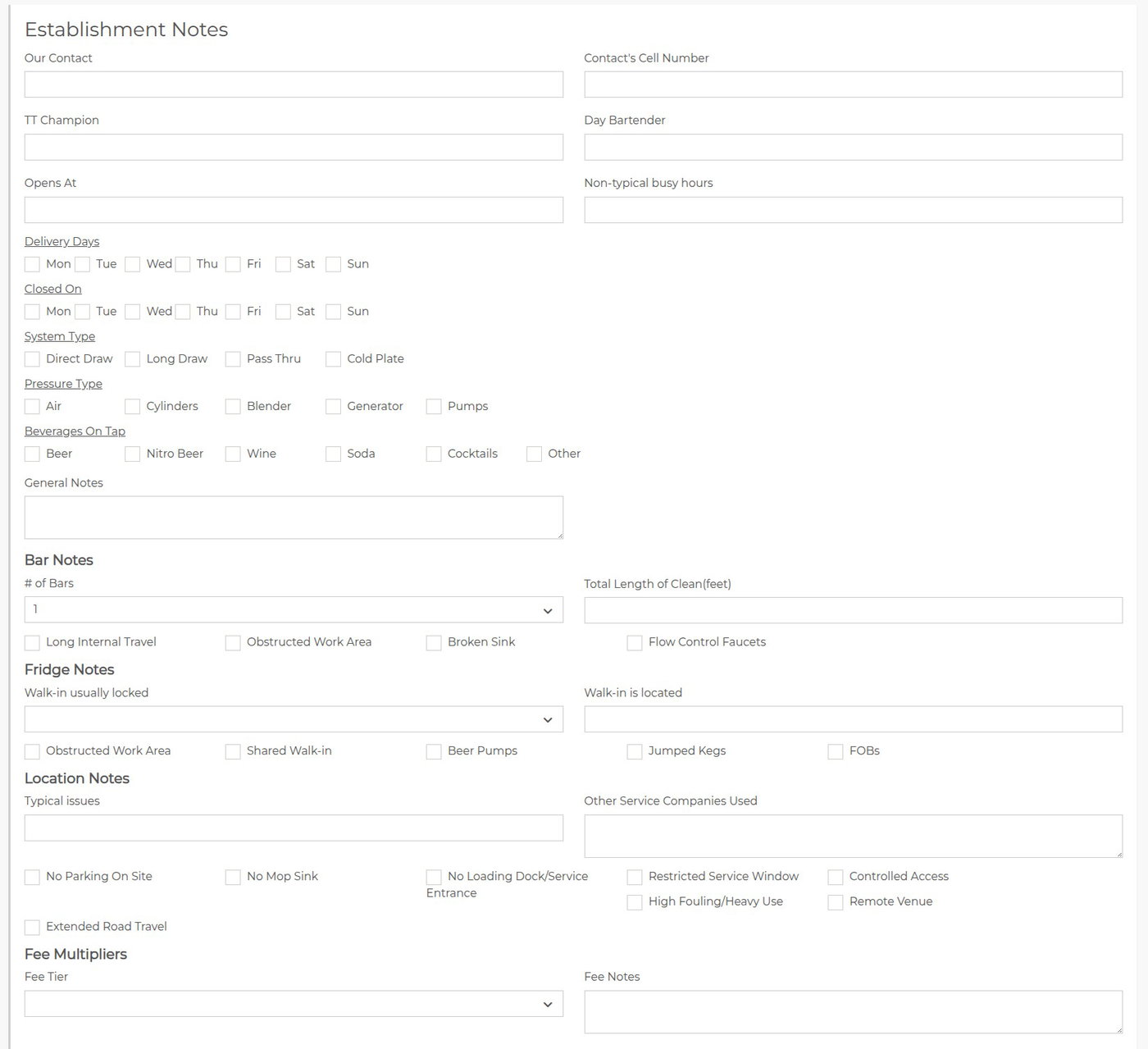
Note: You may not find FOBs challenging, or perhaps every one of your establishments has them so they are a moot point. In this case, you can ignore the FOB box, as it is irrelevant to the exercise. You can apply this thinking to any operational challenge.
Once you have an understanding of how you want to weigh the operational challenges, you can begin to assign a Fee Tier to each establishment.
Fee Tiers
Select the fee tier from the drop-down list. There are 15 tiers to choose from. You do not need to use all 15 tiers; they are there for clients who wish to be highly granular with fee tiers.
Tier 1 should be your base tier, and you should increase the tier as the establishment becomes more complicated. You can add a higher-tier fee later, but you can’t go below Tier 1. The higher the tier, the more challenging the establishment.
Fee Notes
Optionally, you can add some notes in the Fee notes text box. Examples could be the date you set the fee. Or any notes as to why you selected that tier.
Who Sees Fee Tiers?
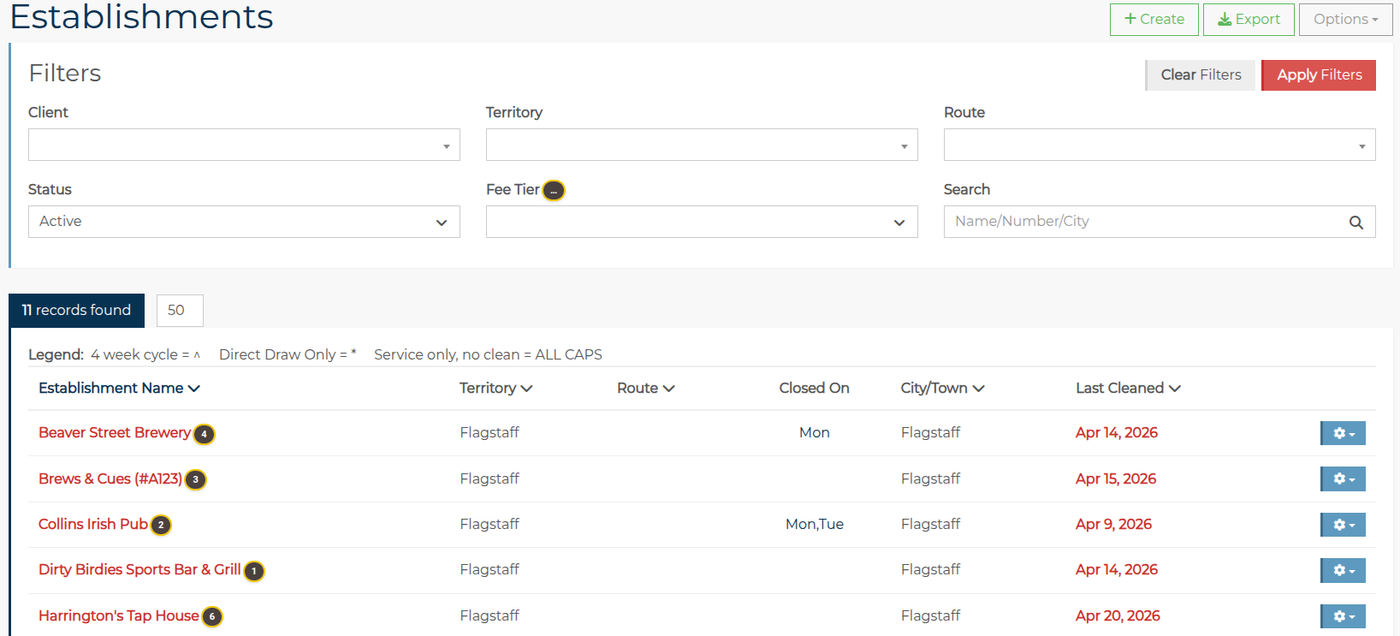
Those in the role of “Client” (draft service owners/managers, our direct client) can filter by and see each establishment’s fee tier identifier on the Est page as a number in a brown circle:
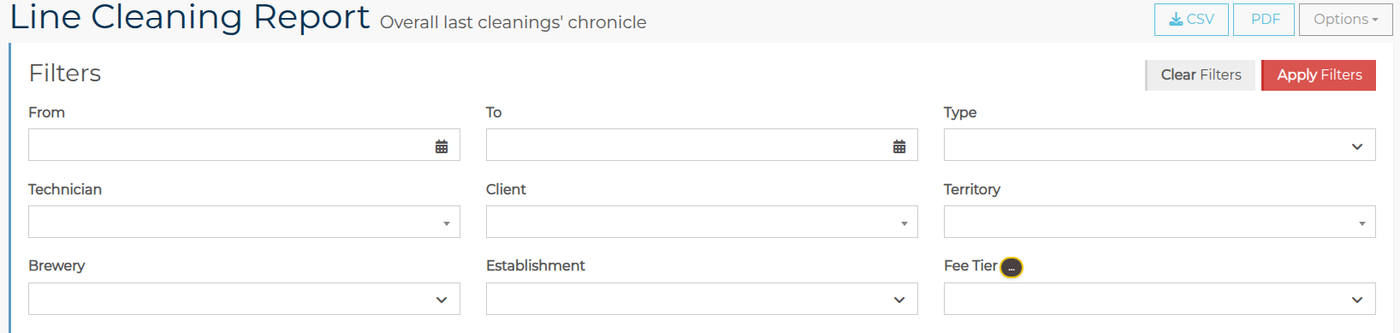
Clients can also use fee tiers as a filter on all report pages. This is handy if you invoice a distributor based on fee tiers. You can run a report for each tier and charge accordingly.
Only Client roles can see the fee tier identifier and filter by fee tiers.
Anyone who has access to the Establishment Details section (Line Cleaners, Service Managers, Service Managers+) can add or edit the checkboxes and notes in the Est Details section.
Bar/Store Managers or Brewery reps do not have access to view the Establishment Details or anything related to Fee Tiers.
Fee Multiplier Calculator
Here is a calculator we built to help you perform calculations based on a set of service conditions:
https://docs.google.com/spreadsheets/d/1LkWmK9J_ZRU_YNo52qQ3oXlhsXb14oIT2d-vXG_L8kg/template/preview
You will need to make a copy of it before you can use the template.
Fee Tiers As A Sales Tool
Customers generally baulk at any quote; it doesn’t matter if they think it is a fair price or not. Having a set standard for your fees and a way to explain why they are paying more than someone else is a great sales tool when you are asked to negotiate your fees or told they are too high.
Remember that sometimes, some of the business is not worth the business. Dropping your fees for a complex job with many operational challenges will leave future you frustrated and resentful of your current you.